
Axis relief teams
Axis relief teams is an end-to-end software solution designed to ensure your relief team can be quickly onboarded, utilised and maximised across your organisation.

Multi-sector workforce management solutions












Reduce agency costs and raise the quality of your relief team
By investing in your relief team, the impact will be felt across the organisation.
More and more organisations are seeing the benefit of a well established relief team. Besides saving around 40% on the cost of using recruitment agencies, investing in your relief team with training and supervision raises the quality of your contingent staff, increases retainment and improves overall moral.

End-to-end platform
Built-in tools, automations and real-time notifications ensure managing your relief team is simple and straight forward.
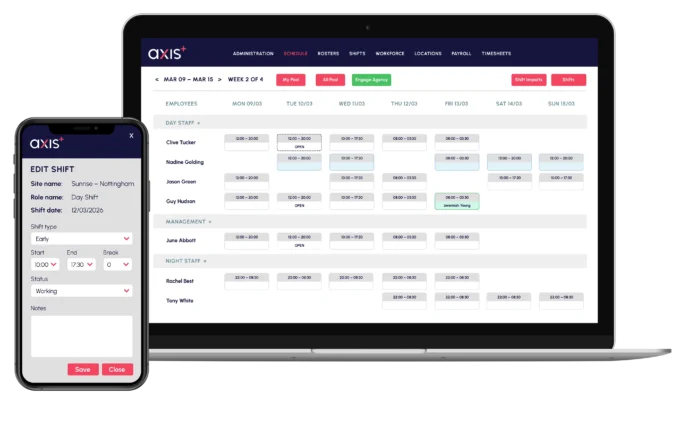
Axis relief teams supports large and small teams across single or multi-site organisations. Tools and features facilitate a self-managing, end-to-end process that incorporates; onboarding, shift management, time and attendance tracking, payroll reporting and auditing. Through colour coding, the weekly schedule provides visibility of who is an employee, relief worker or agency worker.

"Roisin Werner, Depaul UK"
The software and services provided by Axis Plus have been instrumental in the development and management of our flexible workforce. The provision of a neutral vendor platform and bank management solutions, have enabled us to streamline processes, improve efficiencies, and ensure our contingent staffing needs are met with accuracy and speed. In addition to the cost and efficiency savings, what is equally valuable to Depaul, and what we believe sets the company apart, is their excellent and responsive customer service.
How to establish, grow, maximise and retain your relief team

Compliance, contracts and oversight
Create robust processes and procedures to ensure your new workforce is compliant, well managed and included.
Invest in a digital infrastructure
Ensure your infrastructure efficiently manages bookings, automated notifications, timesheets and payroll files, with clear and real-time visibility.

Staff retention starts with good support
Training, support and supervision will ensure your relief team feels included and an important part of the business.
Why develop a relief team?
What are the advantages of having a relief team?
+ -For organisations with a large ad hoc shift need, it's preferred to have a team available that know the organisation and are familiar with the processes, procedures and protocols as it can mean less management time and less support is needed.
How do relief teams save organisations money?
+ -By reducing the use of recruitment agencies, organisations can save over 40%.
How is quality improved by having an internal relief team?
+ -By directly employing contingent staff, organisations have the opportunity to train and manage the workforce, resulting in better outcomes for all stakeholders.
How do organisation create internal relief team?
+ -To build a successful, well functioning relief team, it's important to think carefully and plan ahead. As for all employees, the critical infrastructure needs to be in place before you start, which as a minimum, needs to include:
+ Recruitment criteria
+ Contracts (zero hours / casual contract)
+ Rates of pay
+ Job descriptions
+ Line management
+ System onboarding
+ Payroll processes
How are the staff that make up the relief team generally recruited?
+ -To successfully develop an internal talent pool, organisations need to be creative and establish different pathways to attract and recruit flexible workers. It's not uncommon for talent pools to be made up of:
+ Past applicants
+ Former employees (boomerang hires)
+ Referrals
+ People met at events
+ Individuals identified through proactive sourcing
What are the reasons internal relief teams fail?
+ -The principal reasons why workers join talent pools is to work when they're available and to get paid. If the hiring organisation doesn't have work available or doesn't have the infrastructure to make the contingent workforce aware of work opportunities, they will leave. Similarly with pay, if the payment process isn't well managed, the workforce will become frustrated and look elsewhere for work.
Can Axis relief teams help us to put the processes and procedures in place to get started and help us to maintain it?
+ -Absolutely. We have over 20 year's experience helping clients to build successful relief teams. We also have the software infrastructure that facilitates all aspects of onboarding, shift management, time and attendance and payroll reporting.